No model has ever woken up at 2am because the answer was fine but not right. I have. That gap is the job now.
Every release makes the models more capable. They draft architecture blueprints, untangle regulation, and generate working code. In seconds. Agents run whole workflows now, not single steps. Intelligence is the part I can now delegate.
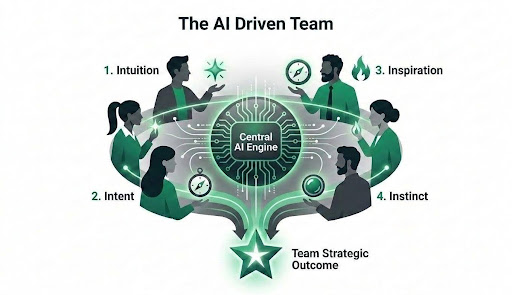
Four things move to the front: Intuition, Intent, Inspiration, Instinct. Not a checklist. They show up in that order, at different points in the same piece of work. None of them are things I can prompt for.
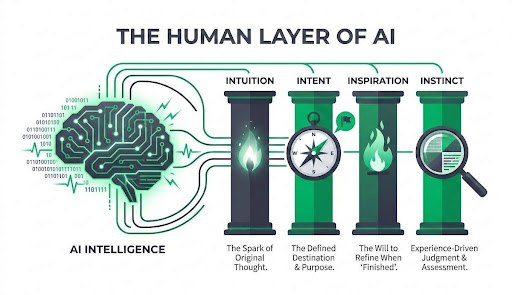
1. Intuition: Where it starts
The best ideas about what needs to be done arrive when I am not looking for them. In the shower, during meditation, when the mind is quiet and something surfaces on its own.
Others arrive while I am focused on something entirely unrelated. A connection appears between two things I had never thought to put together.
In the recent movie ‘Governor’, there is a scene where the RBI Governor comes up with the strategy to buy time in solving a national crisis after noticing a staff member borrowing from one colleague to repay another. Dramatised, certainly. But that is the shape of it: the answer was in the room, at a scale nobody was looking at.
Not every spark is worth pursuing. Knowing which ones to follow is a skill in itself. But the spark is where everything begins, and no prompt produces it. Every conversation with an AI starts with a human who decided that something deserved attention.
This matters more as the models improve, not less. When building gets cheap, knowing what to build becomes the differentiator.
2. Intent: What we are solving for
Intuition tells you something deserves attention. Intent is deciding what would count as having dealt with it.
Not the task. The outcome. Not “write me a migration plan” but what has to be true once the migration is done, what cannot break while it happens, and what I am willing to trade to get there. The request is downstream of that. Most of the work of intent happens before anything is typed.
Get it wrong and you get excellent work pointed in the wrong direction, delivered very fast. The model has no way to tell you it is solving the wrong problem, because from where it sits there is no wrong problem. There is only the one you handed over.
One practical observation. Models like Opus do better when you give them the intent rather than the approach. Tell it where you want to land and it will often find a better path than the one you had in mind. Prescribe the path and you get exactly what you asked for, and nothing beyond it.
There is a second half to intent, and it is the harder one. The model does not have to live with being wrong. I do. It can be confidently mistaken at no cost to itself, and it will be, and the accountability for that sits with me. Intent is where I take that on, before the work starts rather than after it fails.
3. Inspiration: The will to keep going when AI thinks it is done
This is the one I feel most strongly about, and it is the 2am problem I opened with.
Every AI response has an endpoint. The model answers and it is finished. Tell it the solution is good enough and it will agree with you and never return to it.
I was building a design framework recently and using AI to help communicate it. The visualisations were good, better than what I would have produced myself, I knew it. Something still told me the framework could be sharper. That signal was instinct. What happened next was not. Instinct tells you something is off. It does not make you go back to a thing that is already working.
So I took it to colleagues and asked where it did not sit right. They told me. I reworked it. Then again. Until it clicked, and the same people who had struggled with the first version understood the new one without me explaining it.
The model had no reason to push. From where it sat, the job was done.
The same thing happened at Intellect, at a much larger scale. For three years the industry has told one story about AI in software delivery. Developers write code faster, analysts summarise faster, testers generate cases faster. It is also the answer the tools hand you, because it is what they are built to optimise. The numbers were good. Really good. We could have set that as the target. Plenty of people did.
We kept looking, but not at the tools. We went back to how projects actually get executed. How work packets get defined and closed. What happens at the handoff between two people. Where context gets lost.
The individual gains were real, but the opportunity was an order of magnitude larger at the project level. So we changed the approach, the engineering methods, and the measure. Not how fast a person finishes a task. How long the project takes. The second number does not move just because the first one does. That second number is coming down.
No model was ever going to tell us to aim higher. That had to come from us.
4. Instinct: Differentiating good from not-good
I used the word twice in the last section without stopping to say what I meant by it.
Instinct is judgment arriving ahead of its own reasoning. You read a narrative and you know whether it lands. You look at a design and you know it will not hold before you can say why. The reasons catch up a day or two later.
It is close enough to intuition that the two get treated as one thing, but they arrive at different moments. Intuition came unasked, like the Governor observing his staff member’s approach. Instinct fired when the visualisations were in front of me and something said not yet.
It is not gut feel and it is not prejudice, though it is easy to mistake for both. It is experience accumulated over years, compressed into something faster than conscious reasoning. Hundreds of similar situations whose outcomes I watched, condensed until only the signal remains and the individual cases are gone.
Instinct is not a veto. It is a flag. It tells me which of the hundred things in front of me deserves a harder look. AI can do that at a depth and speed I cannot match. My job is to decide where to point it.
Which is also why it has limits. Instinct is worth trusting in the areas where you have actually seen how things turned out. Outside those areas it is a preference in a nice suit.
What this means in practice
None of this adds up to trusting your gut over the machine. Every one of the four I’s is a way of pointing the machine better, not a reason to override it.
I read somewhere that two roles will matter most in IT from here. Knowing what to do, and having the system depth to solve the problem once AI has finished thinking. Those are the first and the last of my four. Intent and inspiration are what carry you between them.
Intelligence is no longer the job. Intuition, Intent, Inspiration and Instinct are. The professionals who matter will be the ones who bring them to the table. The teams that matter will be the ones that have them in the right combination.