

Foreword

Empowering Banks to Unlock Data and Innovate with eMACH.ai

Arun JainAt the core of digital transformation lies the ability to integrate and utilise both structured and unstructured data. Traditionally, banks have leveraged structured data effectively, but unlocking the value of unstructured data requires advanced AI-driven technologies.

This is where our eMACH.ai framework comes into play. It is built on six principles (Events, Microservices, API-first, Cloud-native, Hyper-personalisation, and AI), creating a foundation for modern banking.

AI is not just a technological upgrade, but a fundamental shift in how banks operate, make decisions, and serve customers. By leveraging structured AI frameworks, banks can mitigate legacy complexities, harness the power of data, enhance compliance, and accelerate innovation.

Arun Jain

Chairman and Managing Director
Intellect Design Arena Ltd
Cover Story

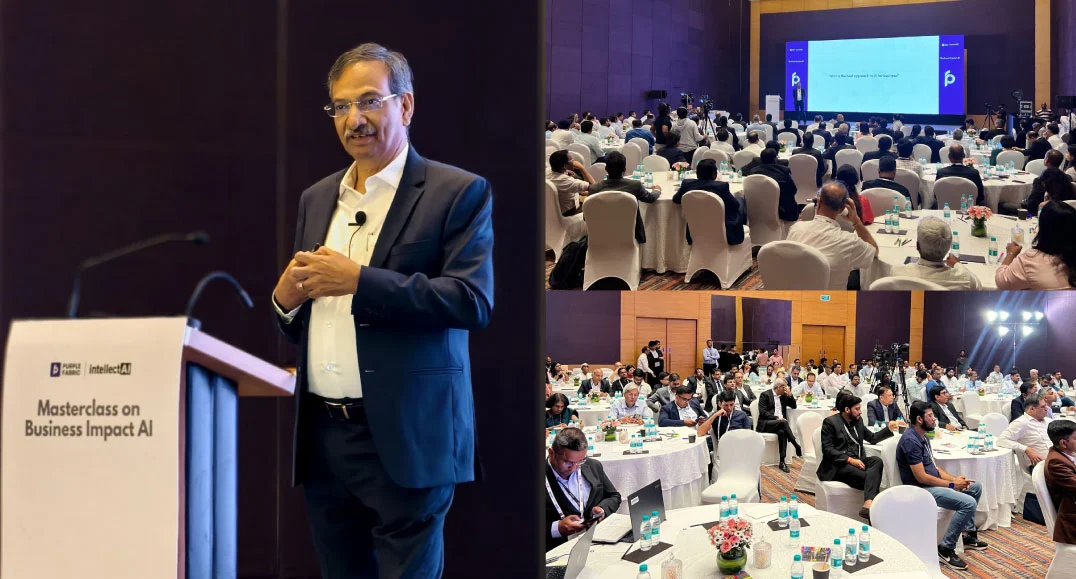
Intellect hosted the in-person Masterclass on Business Impact AI recently in Mumbai,bringing together senior banking and technology leaders for an immersive exploration into the future of enterprise AI. Arun led the session, unveiling how Business Impact AI, powered by Purple Fabric, the world’s first open business impact AI platform, enables financial institutions to achieve engineered business outcomes.

The Masterclass explored:

1. How enterprises can build contextual EnterpriseGPTs grounded in their unique knowledge
2. Why governance, model fit, and cost metering are essential for scalable AI
3. The rise of Enterprise Digital Experts who elevate decision-making, not just productivity
4. The foundational role of the Enterprise Knowledge Garden in powering intelligence at scale
5. And how Purple Fabric is enabling sustainable, enterprise-grade impact globally

Spotlight:

Annual Report FY25: Purple Fabric – The Business Impact Core of eMACH.ai

We have published our Annual Report for FY25. This edition presents a sharp, design-led narrative of how Intellect is accelerating its transformation journey. With a strong focus on AI-powered platforms, data-backed insights, and purposeful innovation, the report reflects how we are building for scale, certainty, and sustainable impact across global financial ecosystems.

Unveiling PF Cloud: The World’s First Open Business Impact AI Platform, Purple Fabric on Cloud

At GIFT City, India’s flagship International Financial Services Centre (IFSC), Intellect launched PF Cloud, the world’s first Open Business Impact AI Platform, Purple Fabric, on cloud. This marks a significant step in advancing India’s position as a global hub for AI innovation, while redefining how enterprises transition from experimentation to accountable, production-grade AI adoption.

Recent Success & Implementation

Intellect in the News

Industry Watch

Seizing the agentic AI advantage

Although nearly 80% of companies have deployed generative AI, most report little financial impact, a gap McKinsey calls the “gen AI paradox”. The article posits that agentic AI, autonomous, goal-driven systems, has the potential to redefine business value by embedding intelligence into decision-making and workflows.

McKinsey outlines a CEO‑led framework emphasising four pillars: selecting high-impact use cases, redesigning workflows, investing in infrastructure and skills, and instituting strong governance. Early adopters, including banks and research firms, have seen efficiency gains of 20–60%, with error reductions and cost savings in the millions.

The article concludes that agentic AI isn’t a toolkit; it’s a strategic transformation that demands end-to-end integration and C‑suite ownership.

AI, align thyself

Although nearly 80% of companies have deployed generative AI, most report little financial impact, a gap McKinsey calls the “gen AI paradox”. The article posits that agentic AI, autonomous, goal-driven systems, has the potential to redefine business value by embedding intelligence into decision-making and workflows.

McKinsey outlines a CEO‑led framework emphasising four pillars: selecting high-impact use cases, redesigning workflows, investing in infrastructure and skills, and instituting strong governance. Early adopters, including banks and research firms, have seen efficiency gains of 20–60%, with error reductions and cost savings in the millions.

The article concludes that agentic AI isn’t a toolkit; it’s a strategic transformation that demands end-to-end integration and C‑suite ownership.

Why Large Language Models Are The Future Of Cybersecurity

Although nearly 80% of companies have deployed generative AI, most report little financial impact, a gap McKinsey calls the “gen AI paradox”. The article posits that agentic AI, autonomous, goal-driven systems, has the potential to redefine business value by embedding intelligence into decision-making and workflows.

McKinsey outlines a CEO‑led framework emphasising four pillars: selecting high-impact use cases, redesigning workflows, investing in infrastructure and skills, and instituting strong governance. Early adopters, including banks and research firms, have seen efficiency gains of 20–60%, with error reductions and cost savings in the millions.

The article concludes that agentic AI isn’t a toolkit; it’s a strategic transformation that demands end-to-end integration and C‑suite ownership.