
Artificial Intelligence (AI) has gained significant momentum in recent years across industries, and the supply chain finance sector is no exception. AI-powered solutions are transforming the supply chain finance landscape, offering new levels of automation, speed, and accuracy in managing supply chain finance operations.
Supply chain finance involves managing the financial transactions and relationships between buyers, suppliers, and other parties involved in the supply chain. The process includes invoice processing, payment processing, and financing for suppliers. AI in supply chain finance can help streamline these processes, reducing manual intervention and errors while improving efficiency, accuracy, and speed.
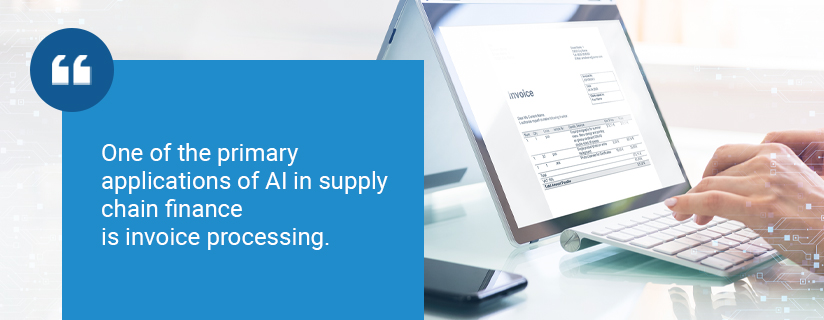
One of the primary applications of AI in supply chain finance is invoice processing. In traditional invoice processing, invoices are manually reviewed, and data is manually entered into systems. This process is time-consuming and prone to errors. With AI, invoices can be automatically processed using Optical Character Recognition (OCR) technology, which extracts data from scanned invoices and feeds this information into an automated system. This approach can significantly reduce processing time and increase accuracy, leading to fewer errors and faster payments
Instead of the traditional approach, Banks can now leverage the power of AI for automating invoice processing, which follows the below workflow:
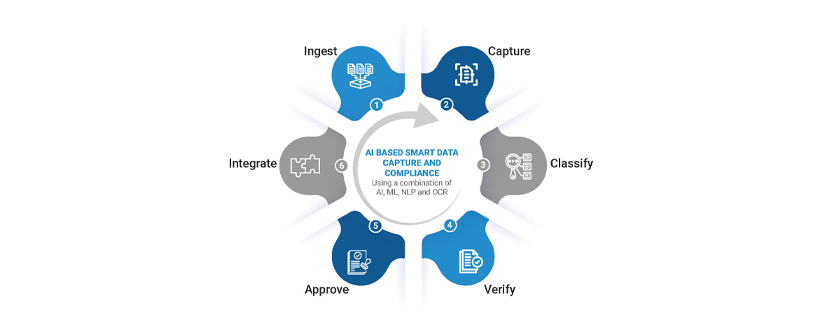
The processing can happen in both real-time or bulk mode. Input data can be structured, semi-structured or even unstructured with easily accessible upload formats like Word, PDFs or even images.
The system can ingest the data via email, file upload, Secure File Transfer (SFTP) or even integrated with a 3rd party application. After the data has been ingested, the system captures the data, which can be either image or text-based.
Once the data has been captured, the system classifies it; in the case of an image, the data is enhanced to text through a Machine Learning/Neuro-Linguistic Processing layer, allowing one to view the captured fields online.
The system then validates the field and data type as well as the field format, performs the necessary de-dupe checks and geography specific checks, verifying all purchasing data, master data and tax data and completes any exception handling.
Post verification, the next step in the process is the approval phase; it handles invoice approvals and auto-initiates workflow post-initial approval; not only that, but it also manages the approval hierarchy.
All this gets clubbed into an integration layer, a cloud-Native API-ready solution that can seamlessly integrate with the business process, supporting a full range of output formats including Json,CSV/XLS, TXT, PDF and API.
These steps help in getting your data validated and remediated through contextual filtering and machine learning, eliminating paper, saving time and cost, improving accuracy and reducing risk.
An extended use of AI in supply chain finance is fraud detection. AI-powered fraud detection systems can analyse data from multiple sources, including invoices, purchase orders, and shipping records, to identify anomalies that may indicate fraudulent activity. It helps prevent fraudulent transactions e.g. by detection of duplicate invoices and hence protects buyers and suppliers from financial losses.
In addition to these benefits, AI-powered supply chain finance solutions can provide real-time visibility into the status of payments, invoices, and other transactions, enabling better decision-making and more efficient cash flow management.
Using AI in supply chain finance offers several benefits, including increased efficiency, accuracy, and speed in managing financial operations, improved supplier financing access, and better fraud detection and prevention. As AI technology evolves, we expect to see even more innovative solutions in the supply chain finance sector, leading to greater transparency and trust between buyers and suppliers.
The Future of Banking Has Arrived
There can be no doubt that we have reached a significant inflexion point in the evolution of trade finance. Over the past twenty years or so, there has been a major shift away from the use of traditional trade finance instruments such as the documentary letter of credit in favour of supply chain finance, a business which does not dependent upon the labour-intensive processing of documents through the banking system and which therefore lends itself naturally to the process of digitalisation.
In the wake of the Covid-19 pandemic, there is an even stronger demand to eliminate the use of paper and move towards a wholly digitalised environment. The drive towards digitalisation is supported by a number of industry and government initiatives to introduce new rules and standards which will finally enable us to overcome the barriers which have stood in place for centuries. The passing of the UK Electronic Trade Documents Bill is a real game-changer for world trade given the amount of global trade that is conducted under English law.
We are finally entering an era which will enable the legal enforcement of electronic transferable records both domestically and cross-border. Transferable records will not only entitle the holder to claim the performance of an underlying payment obligation or undertaking but also allow the transfer of that claim by transferring possession of the underlying digital negotiable instrument, including bills of lading, bills of exchange, promissory notes and warehouse receipts.
Corporates are looking to diversify and simplify their global supply chains and hence require to make use of efficient counterparty on-boarding tools. At the same time, there is a common desire to build back better and address head on the existential threat of global warming as well as support measures for social equality whilst implementing the appropriate governance measures.
Technologies like artificial intelligence, machine learning, natural language processing, smart objects and advanced data analytics can all be deployed to support the digitalisation of trade, trade finance and SCF.
API-first digital architectures with embedded AI designed to deliver solutions that are composable, extensible and flexible are helping banks automate processes, optimise resources, reduce complexity and drive growth and profitability supported by data driven decision making.
The evolution of generative AI and the eventual adoption of deep tier SCF will serve to transform the way we manage and finance our supply chains going forward. The future of banking has arrived.